
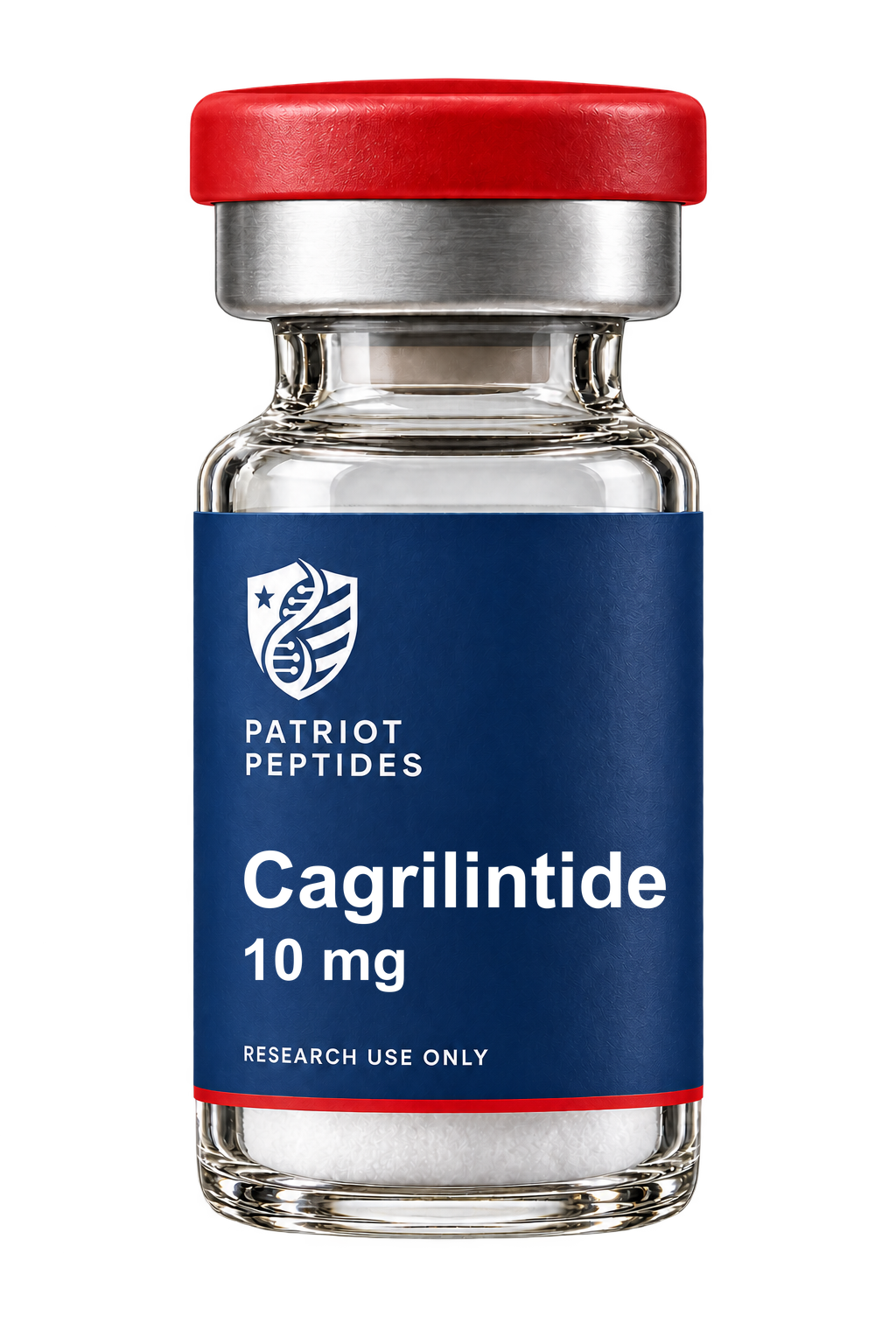
Cagrilintide
10mg
A long-acting amylin analog used in laboratory studies of satiety and metabolic signaling.
Bundle & save
Strength
- Ships in 24 hours
- HPLC & endotoxin verified
- Encrypted checkout
Research details
Areas of research interest
Cagrilintide is studied for body-weight reduction, both alone and combined with semaglutide. It targets the amylin satiety pathway, which is distinct from the incretin pathways used by GLP-1 agonists. Cagrilintide is investigational and is not approved by FDA for any use.
Overview
Cagrilintide is a long-acting, acylated analogue of amylin, a hormone co-secreted with insulin by pancreatic beta cells that signals satiety. Acylation extends its half-life well beyond that of native amylin.
Research summary
Phase 2 monotherapy. In a 26-week dose-finding trial of 706 adults with overweight or obesity, cagrilintide arms lost a mean 6.0% to 10.8% of body weight, compared with 3.0% on placebo [1]. The highest-dose arm also outperformed liraglutide (10.8% vs 9.0%) [1].
Combination with semaglutide. The Phase 3 REDEFINE 1 trial randomized 3,417 adults to cagrilintide plus semaglutide, either agent alone, or placebo for 68 weeks [2]. Mean weight reduction was 20.4% with the combination, 14.9% with semaglutide alone, 11.5% with cagrilintide alone, and 3.0% with placebo [2].
Regulatory status. Novo Nordisk submitted the cagrilintide-semaglutide combination (CagriSema) to FDA in December 2025. Cagrilintide on its own is not approved for any indication.
References
- 1. Lau DCW, et al. Lancet. 2021;398(10317):2160–2172. PMID: 34798060
- 2. Garvey WT, et al. N Engl J Med. 2025 (REDEFINE 1)
For laboratory research use only. Not for human or veterinary use. This product is not a drug, food, cosmetic, or dietary supplement and is not intended to diagnose, treat, cure, or prevent any disease. These statements have not been evaluated by the FDA.