
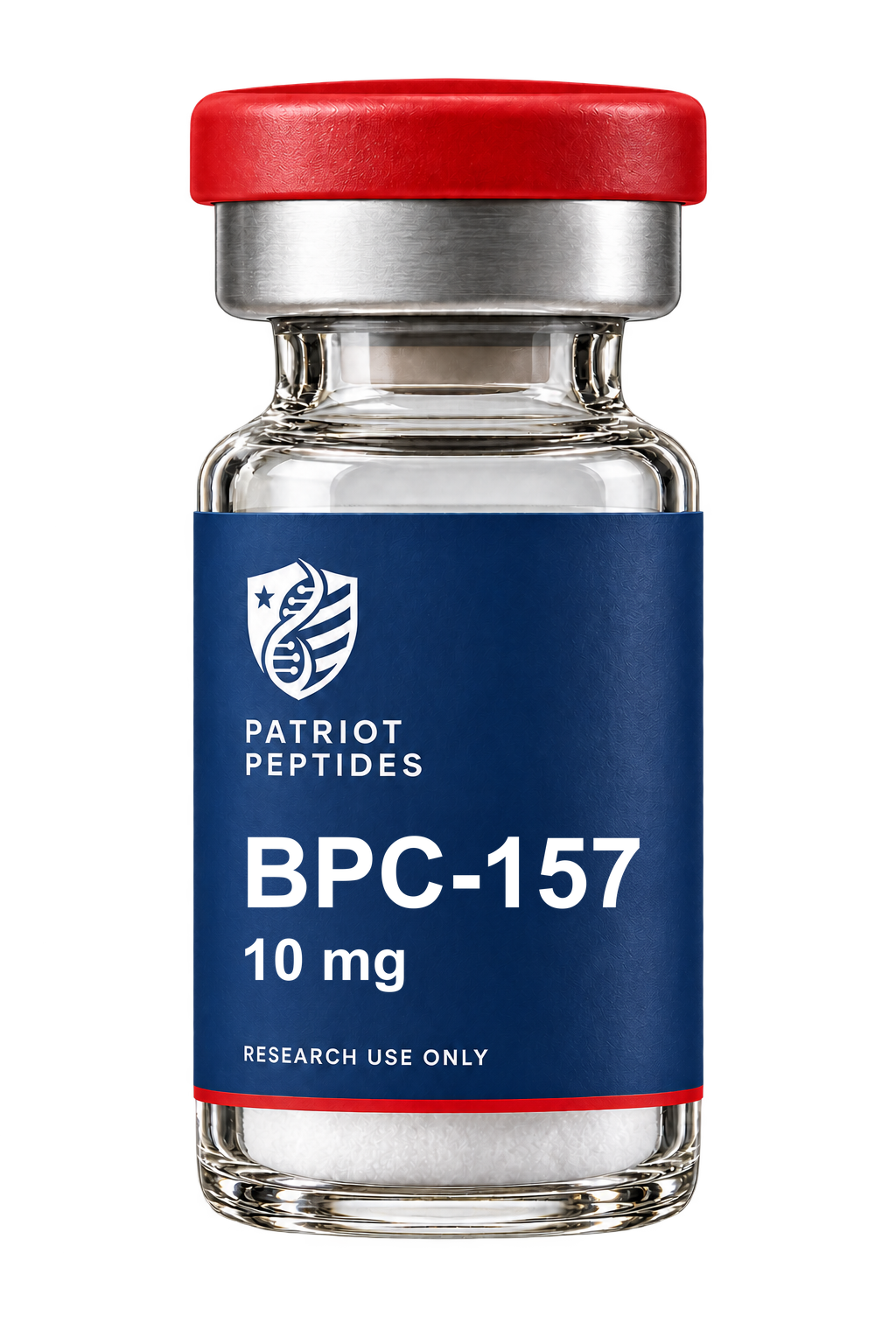
BPC-157
10mg / 20mg
A synthetic 15-amino-acid peptide modeled on a sequence found in gastric proteins.
Bundle & save
Strength
- Ships in 24 hours
- HPLC & endotoxin verified
- Encrypted checkout
Research details
Areas of research interest
BPC-157 is most often discussed in connection with soft-tissue repair. Published models cover tendon, ligament, and muscle injury, as well as bone healing. A second major research area is gastrointestinal cytoprotection, including mucosal injury and post-surgical intestinal healing. These areas account for most of the interest in its potential clinical applications, although no efficacy in humans has been established.
Overview
BPC-157 (Body Protection Compound-157) is a synthetic pentadecapeptide, a 15-amino-acid sequence noted for its stability in human gastric juice. It is among the most frequently studied peptides in preclinical tissue-repair research, and most of that work has been done in laboratory animals.
Research summary
Human data. Published human research is limited to small, uncontrolled studies. These include a retrospective knee-pain series of 16 patients, most of whom self-reported relief [1]; a 12-patient interstitial cystitis pilot [2]; and a two-person safety study [3]. A Phase I trial of an oral formulation in healthy volunteers was conducted, but its results were never submitted (NCT02637284). A 2025 systematic review rated the musculoskeletal evidence at Level IV and V [4]. No adverse events were reported in these small studies, though long-term human safety has not been characterized [3].
Connective tissue. In a rat Achilles tendon transection model, BPC-157 was associated with improved functional and biomechanical healing compared with controls [5].
Cellular mechanisms. In tendon fibroblasts, BPC-157 activated FAK–paxillin signaling, increased cell migration, and improved survival under oxidative stress, without directly affecting proliferation [6]. Rodent muscle and tendon studies tied its healing effects to upregulated VEGF expression, though it showed no direct angiogenic effect in cell culture [7].
Gastrointestinal models. Early research centered on GI cytoprotection, including alcohol-and NSAID-induced lesions and intestinal anastomosis healing in rats [8].
References
- 1. Lee E, et al. Altern Ther Health Med. 2021. PMID: 34324435
- 2. Lee E, et al. Altern Ther Health Med. 2024. PMID: 39325560
- 3. Lee E, et al. Altern Ther Health Med. 2025. PMID: 40131143
- 4. Vasireddi N, et al. HSS J. 2025. PMID: 40756949
- 5. Staresinic M, et al. J Orthop Res. 2003;21(6):976–983. PMID: 14554208
- 6. Chang CH, et al. J Appl Physiol. 2011;110:774–780. PMID: 21030672
- 7. Brcic L, et al. J Physiol Pharmacol. 2009;60(Suppl 7):191–196. PMID: 20388964
- 8. Sikiric P, et al. Curr Pharm Des. 2011;17(16):1612–1632. PMID: 21548867
For laboratory research use only. Not for human or veterinary use. This product is not a drug, food, cosmetic, or dietary supplement and is not intended to diagnose, treat, cure, or prevent any disease. These statements have not been evaluated by the FDA.